Medical and university shift workers know the exhausting reality of coming home after a long day to a dog bouncing off the walls. Physical exhaustion simply does not equal mental satisfaction for high-energy breeds.
We see this disconnect constantly at Dog Daycare Durham. The facility was founded on a simple premise: dogs need safe, structured enrichment, rather than just a basic holding area while their owners work.
This approach changes everything for busy pet parents.
Our team has spent over 15 years working with high-energy dogs of every breed and temperament across the US. The dogs who are truly calm and well-adjusted receive a balanced diet of both physical activity and cognitive stimulation.
We will outline the exact mental enrichment ideas for high-energy dogs that work all day and show you how to easily implement them.
Why Physical Exercise Is Not Enough
It seems counterintuitive to see a dog pacing or whining thirty minutes after a long run. The reason is simple: physical exhaustion leaves the body tired but the mind restless.
We often compare this to a person running five miles on a treadmill and then sitting in a featureless room. Dogs experience the exact same disconnect when their brains crave problem-solving and engagement. Excess energy quickly manifests as anxiety, destructive behavior, and hyperactivity without those specific cognitive inputs.
“A recent study published in the Journal of the American Veterinary Medical Association discovered that shelter dogs given enrichment activities twice daily spent 65% more time resting quietly after just three days.”
Recent studies in canine cognition consistently show that 15 to 20 minutes of focused mental stimulation can tire a dog out as effectively as a 30-minute physical walk. Our clients in the US medical field find this data incredibly helpful.
You can achieve better results in less time by engaging your dog’s brain.
Mental Enrichment Ideas for High-Energy Dogs That Work All Day
Food serves as your most powerful cognitive tool. Wild canids like wolves and foxes spend up to 60% of their day searching for food in their natural habitats.
We highly recommend mimicking this natural foraging behavior at home. Making dogs work for their meals activates the problem-solving centers of their brain in deeply satisfying ways.
Our favorite methods require very little setup time for busy shift workers. You can ditch the regular food bowl entirely and replace it with interactive feeding systems.
Puzzle Feeders and Slow Bowls
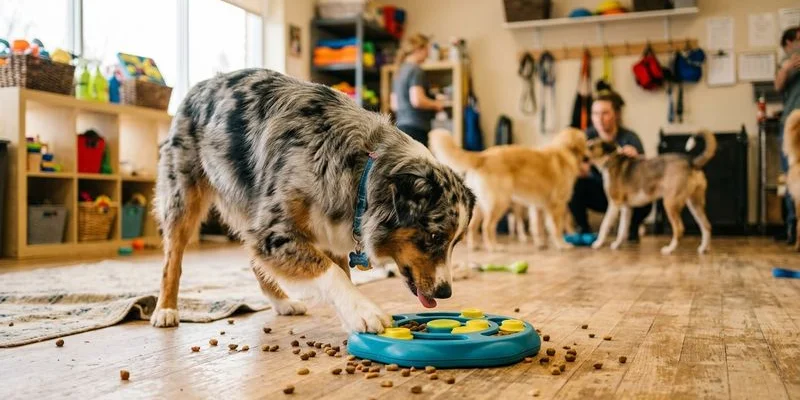
Puzzle feeders come in varying difficulty levels and require your dog to slide, flip, or manipulate compartments to access their kibble. You should start with easy puzzles and gradually increase the complexity as your dog masters each level.
We frequently use the Outward Hound Hide N’ Slide for beginners. This specific toy features six treat-hiding compartments that dogs can easily open with their muzzle.
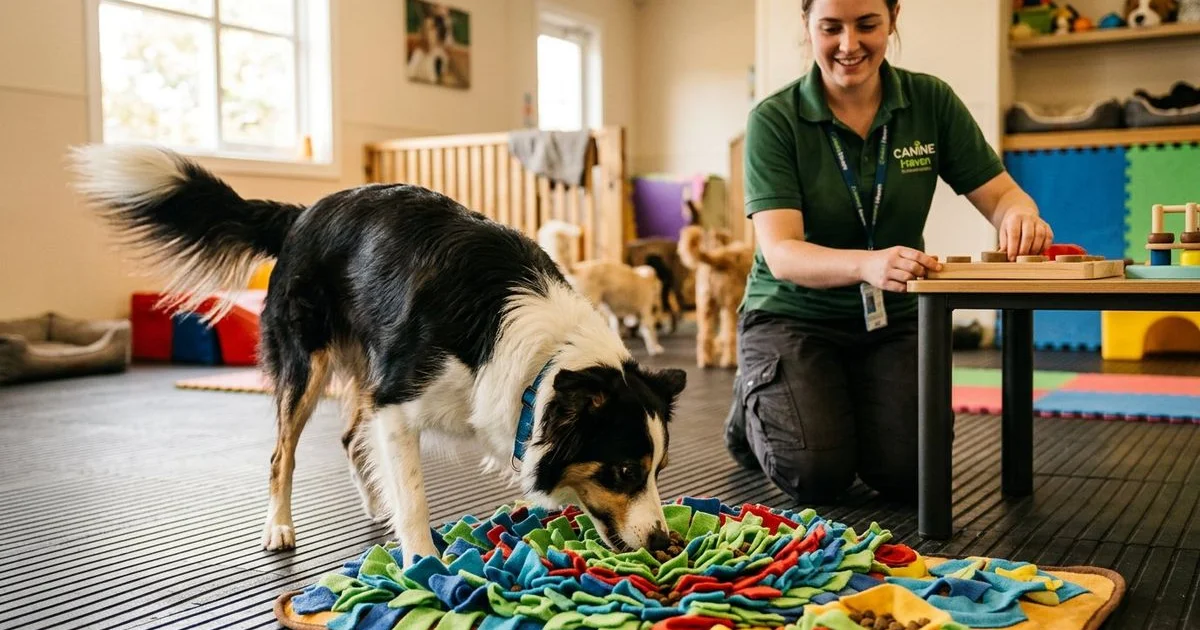
Advanced dogs benefit greatly from the Nina Ottosson MultiPuzzle, which challenges them with multiple steps. Another excellent option is the Paw5 Wooly Snuffle Mat, which perfectly mimics the experience of foraging through tall grass.
The table below compares three popular puzzle feeders to help you choose the right starting point:
| Feeder Type | Best For | Challenge Level | Time to Complete |
|---|---|---|---|
| Outward Hound Hide N’ Slide | Beginners and puppies | Easy | 5 to 10 minutes |
| Paw5 Wooly Snuffle Mat | Fast eaters and seniors | Medium | 10 to 15 minutes |
| Nina Ottosson MultiPuzzle | High-energy working breeds | Advanced | 15 to 30 minutes |
Frozen Kongs and West Paw Toppls
A traditional Kong stuffed with a mixture of xylitol-free peanut butter, yogurt, kibble, and banana provides incredible mental stimulation. Freezing the toy for several hours creates a sensory element that keeps your dog engaged for 20 to 40 minutes.
Our team also loves using the West Paw Toppl for heavy chewers. The wider opening makes it significantly easier to clean and allows for more creative layering of different ingredients.
You can create an advanced challenge by layering wet and dry foods. Your dog will encounter new flavors and textures as they work deeper into the frozen treat.
Scatter Feeding and DIY Foraging
Scatter feeding turns a thirty-second meal into a fifteen-minute scavenger hunt. You simply toss your dog’s kibble across the yard or hide small piles throughout a carpeted room.
We consider this one of the easiest enrichment activities to implement because it requires absolutely zero special equipment. A simple muffin tin with tennis balls placed over treats in each cup creates a fun indoor alternative. Pet parents can also roll treats up inside a dry bath towel and tie it into a loose knot, forcing dogs to use their noses and paws to untangle the fabric.
Nose Work and Scent Games
A dog’s sense of smell is roughly 10,000 to 100,000 times more sensitive than a human’s. Engaging this extraordinary sense provides intense mental stimulation that physical exercise alone simply cannot match.
We love seeing the rise in popularity of professional scent tracking. Over 31,000 dogs have participated in American Kennel Club (AKC) Scent Work trials across the US in recent years.
You do not need to compete to reap the benefits of this activity at home. Twenty minutes of sniffing can reduce a dog’s heart rate and promote deep relaxation.
Hide and Seek With Treats
You should start by hiding treats in obvious locations while your dog watches. Release them with a specific command like “find it” and praise them enthusiastically when they succeed.
We recommend increasing the difficulty by hiding treats in different rooms once your dog understands the game. You can eventually have your dog wait in another room while you hide treats under rugs or behind furniture.
The Shell Game
The classic shell game teaches impulse control, problem-solving, and focus simultaneously. You place a high-value treat under one of three plastic cups and shuffle them around on the floor.
Our trainers use this game to build confidence in shy or anxious dogs. Let your dog use their nose to identify the correct cup, and immediately lift it to reward their success.
DIY Scent Trails and AKC Games
You can simulate real tracking work by creating a scent trail through your yard. Drag a smelly treat along the ground to create a path that twists, turns, and ends at a jackpot reward.
We encourage owners to try official AKC target odors for a more advanced challenge. You can hide a cotton swab scented with a single drop of birch, anise, clove, or cypress essential oil in a small tin, as dogs absolutely love using their natural instincts to locate these specific scents.
Training as Enrichment
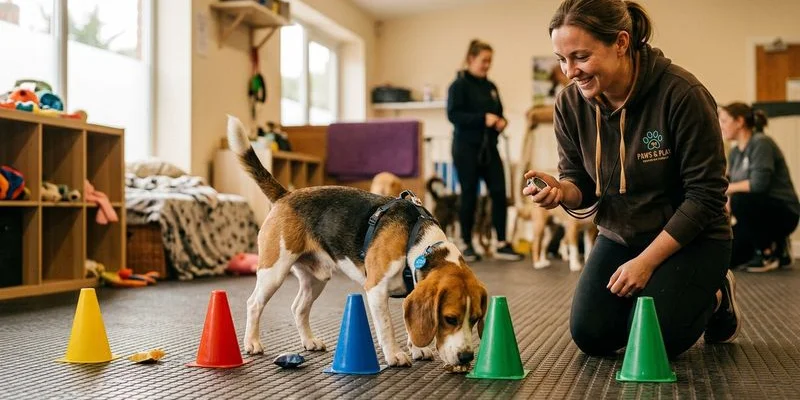
Training sessions offer some of the most potent cognitive challenges available for any breed. Every obedience exercise requires your dog to listen, process information, make decisions, and exercise impulse control.
We suggest keeping these sessions extremely short and positive. Even five to ten minutes of learning a new trick will exhaust a dog more thoroughly than a long walk around the neighborhood.
Learn a New Trick Weekly
You can dedicate ten minutes each day to teaching a completely novel behavior. Tricks like spin, shake, high-five, play dead, and crawl are achievable for most dogs.
Our staff always uses positive reinforcement with high-value treats to keep the dog engaged. The mental effort required to understand a new command burns significant calories.
Impulse Control Games
Exercises like “leave it,” “wait,” and “stay” build essential frustration tolerance and self-control. You should practice these commands during daily meals, before opening doors for walks, and during active play sessions.
We notice a huge difference in dogs who practice daily impulse control. They become less reactive to doorbells, squirrels, and other common household triggers.
Free-Form Shaping Games
Shaping games teach creativity by rewarding your dog for interacting with a novel object. You place a simple cardboard box on the floor and use a clicker to mark any positive interaction.
Our favorite interactions to reward include sniffing, touching the box with a paw, or stepping inside. This specific type of training forces the dog to guess what behavior you want, which requires intense focus and brainpower.
Structured Enrichment at Dog Daycare Durham
Individual cognitive activities form a core part of our daily programming at our Durham facility. You can read more about our individual enrichment to see how these practices work in a professional setting.
We employ certified counselors to design activities customized for each dog’s breed, energy level, and cognitive ability. A typical session at Dog Daycare Durham includes a variety of targeted mental exercises.
Our Daily Enrichment Activities
Every dog requires a different approach to stay engaged and happy. We rotate the following activities to prevent boredom and maximize cognitive development:
- Rotating puzzle toys calibrated specifically to your dog’s current skill level.
- Supervised AKC-style scent work exercises in our indoor play areas.
- Novel object exploration sessions that build confidence in nervous dogs.
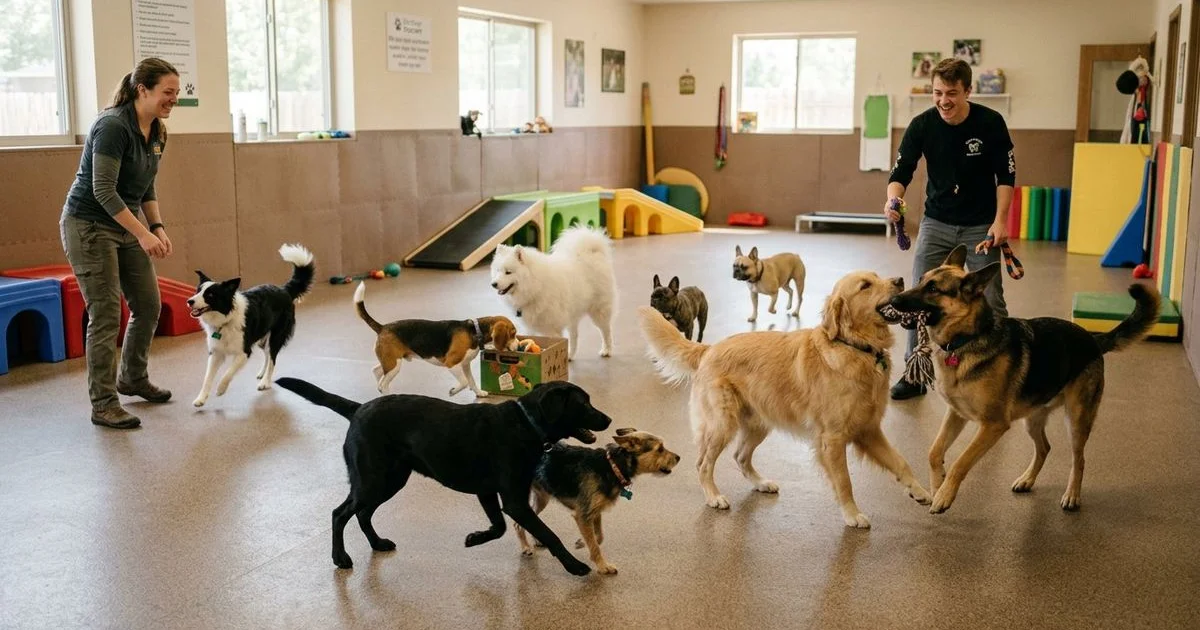
- Social enrichment through carefully managed and supervised group play.
- Sensory stations featuring different textures, sounds, and walking surfaces.
Our approach recognizes that what challenges a Border Collie may completely bore a Basset Hound. The team takes the time to understand each dog’s unique needs through our thorough temperament testing process before they ever join a playgroup.
This customized care ensures every pet goes home mentally satisfied and physically relaxed.
Creating an Enrichment Rotation at Home
The key to an effective cognitive routine is constant variety. Dogs become easily bored with repetitive activities, just like humans do.
We recommend creating a weekly schedule that introduces a different type of challenge each day. A predictable rotation ensures your dog uses different parts of their brain throughout the week. Vacationing pet parents can also hand this exact schedule over to their pet sitter to ensure their dog stays mentally engaged while they are out of town.
You can use the following schedule as a template for your own high-energy pet:
| Day | Activity Type | Specific Example |
|---|---|---|
| Monday | Food puzzle | Outward Hound Hide N’ Slide with breakfast |
| Tuesday | Scent game | Treat hide and seek in the living room |
| Wednesday | Training | Ten minutes of new trick practice |
| Thursday | Social enrichment | Daycare play session |
| Friday | Novel experience | Exploring a new walking route or local park |
| Saturday | DIY project | Frozen West Paw Toppl or muffin tin puzzle |
| Sunday | Free choice | Combine two of your dog’s favorite games |
The Enrichment Mindset
Incorporating mental enrichment ideas for high-energy dogs that work all day is not a one-time fix. Cognitive stimulation is a daily practice that must become as routine as providing fresh water and physical exercise.
The frantic hyperactivity decreases, the destructive chewing fades, and you are left with a genuinely calm companion.
We guarantee that shifting your perspective from purely physical needs to holistic mental health changes everything. Professional support makes a massive difference for busy families juggling demanding US work schedules.
Contact Dog Daycare Durham at 919-617-0849 or visit our facility at 600 Park Offices Drive, Suite 300, to set up an evaluation.
Our extended hours from 6:30 AM to 7:30 PM easily accommodate medical shifts and university schedules. You can even log into our 24/7 webcams to watch your dog enjoy every single moment of their structured playtime.
Want the Best Care for Your Dog?
Schedule a free Interview Day and see why Durham pet parents trust our certified counselors.
Schedule Free Interview Day