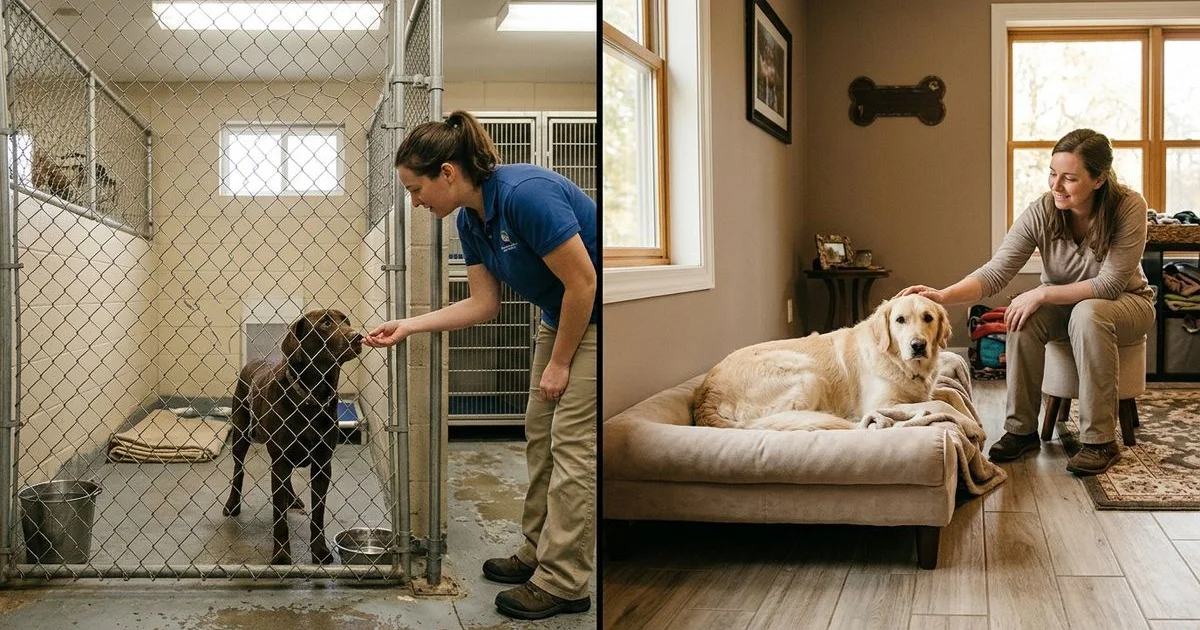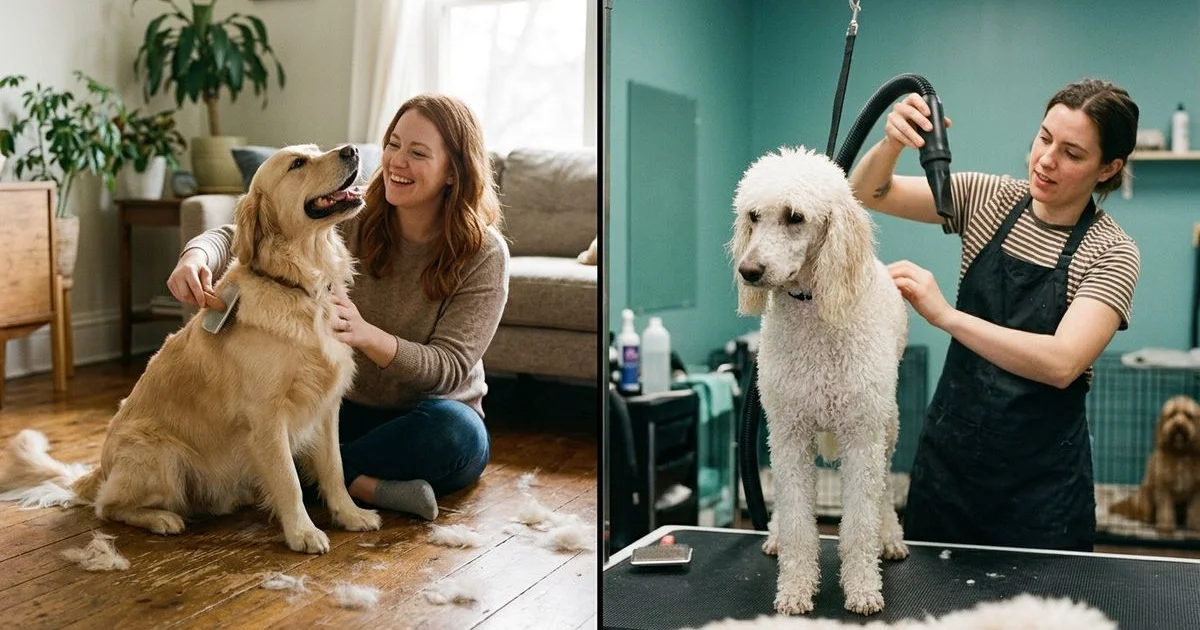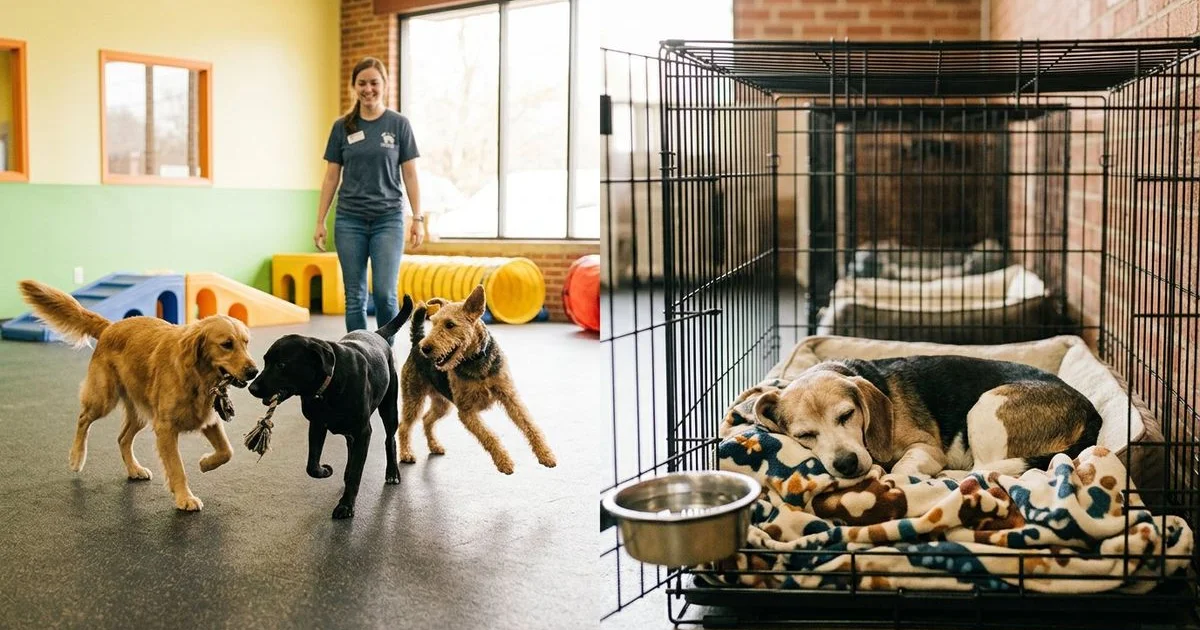
You know how exhausting a 12-hour shift at the hospital or a long week of back-to-back meetings can be. Our team at Dog Daycare Durham sees many busy professionals drop off their dogs hoping for a full day of nonstop exhaustion. A tired dog is often viewed as a happy dog, but this raises a critical question about Open Play vs. Crate Rest at Daycare: Which Is Better for Your Dog?
We founded this facility on the premise that dogs need safe and structured enrichment rather than pure chaos.
The reality is that continuous, unstructured play is rarely healthy for any pet. Our team will break down the exact behavioral science behind play versus rest and share practical ways to evaluate your pet’s daily routine.
Understanding Open Play
Open play usually brings to mind a lively room full of dogs wrestling, chasing, and burning off energy. We recognize that quality group interaction provides incredible benefits when properly managed. According to a 2026 position statement by the American Veterinary Society of Animal Behavior (AVSAB), proper socialization in a puppy’s first three months is crucial. Our certified counselors observe how regular positive interactions build immense confidence and communication skills. The AVSAB even notes that incomplete socialization can lead to behavioral issues, which remain the top cause of shelter relinquishment in the US. We always want to set dogs up for success in social settings.
The Hidden Risks of Unmanaged Environments
Placing a dog in a chaotic room for ten hours straight carries significant risks. Our staff is trained to spot the early warning signs of overstimulation before play turns negative. When arousal levels climb too high, a dog’s decision-making deteriorates rapidly. We watch out for frantic behaviors like “sharking”, where a dog begins imprecisely mouthing at hands or other dogs because their brain is moving faster than their self-control. Another common sign of overstimulation is abrupt displacement behavior, such as a dog suddenly stopping to furiously sniff the ground mid-wrestle. Our facility never allows dogs to remain in open play indefinitely because chronic stress responses create negative associations with daycare.

Understanding Crate Rest
Crate rest simply means providing a scheduled, quiet space for dogs to decompress and sleep away from the group. We view these rest periods as an essential component of a healthy routine rather than a punishment. The American Kennel Club’s 2026 sleep guidelines report that adult dogs naturally need 12 to 14 hours of sleep per day. Our puppy clients require even more downtime, needing 18 to 20 hours of sleep to support their developing central nervous systems. Human athletes require recovery between intense training sessions. We apply this exact same logic to prevent physical exhaustion and joint strain in your pets.
The Cortisol Connection
Extended periods of high arousal cause cortisol to accumulate quickly in a dog’s system. Our care plans prioritize giving that stress hormone enough time to return to a baseline level. A 2026 report in the Journal of Veterinary Behavior found that stress hormones can remain elevated for up to 72 hours after a severe overstimulation episode. We prevent this lingering anxiety by enforcing mandatory nap times. Scheduled downtime allows dogs to mentally organize their recent social experiences.
- Physical Recovery: Muscles and joints get a chance to rest, reducing the risk of sprains.
- Cortisol Regulation: Scheduled naps prevent the hyperactive, restless behavior you might see at home after a chaotic day.
- Impulse Control: Learning to settle in a quiet space builds essential frustration tolerance.
- Individual Processing: Quiet time helps dogs consolidate what they learned during play.

The Science of Play-Rest Cycling
Canine behaviorists consistently find that the safest environments alternate between active physical exertion and quiet relaxation. Our protocols are modeled after guidelines from the Professional Animal Care Certification Council (PACCC), which emphasize avoiding prolonged arousal states. A strict 45 to 60 minutes of activity followed by a structured rest interval prevents extreme fatigue. We apply this specific cycling approach because it perfectly mirrors natural canine behavior in the wild.
“A 2026 study published in Applied Animal Behaviour Science shows that dogs participating in structured cycles display far lower cortisol levels.”
Our team witnesses these positive results daily in how calmly guests greet their owners at pickup. Without these breaks, progressively increasing cortisol peaks in the late afternoon. We hear from clients who work long hospital shifts that their dogs sleep peacefully through the night instead of pacing the house.
How Dog Daycare Durham Balances Both
Every pet parent desires peace of mind when heading out for a vacation or a busy workday. Our daycare program utilizes a carefully structured schedule that prevents exhaustion. Certified counselors with over 15 years of experience assess each dog’s energy level continuously. We implement several key strategies to maintain this delicate balance:
- Strict Evaluations: Proper assessment is essential for safety.
- PACCC Guidelines: Dogs are grouped strictly by size, play style, and energy level based on Professional Animal Care Certification Council (PACCC) standards.
- Targeted Enrichment: Quiet activities bridge the gap perfectly.
- Premium Puzzles: Mental stimulation tires dogs out effectively.
We evaluate every new guest thoroughly through our strict temperament testing process before they join a group. Our team also focuses heavily on individual enrichment during the transitions between play and rest. Durable, dishwasher-safe puzzles like the West Paw Toppl toy feature a wider opening than traditional hollow toys. We love using these because the open design prevents frustration while keeping dogs happily engaged for 20 to 45 minutes. A 24/7 webcam system gives you complete transparency into how well this balanced approach works.
What to Look for in a Quality Daycare
Finding the right facility in Durham requires looking past the marketing to see the actual daily operations. We recommend asking specific questions about ratios and schedules during your initial tour. The International Boarding and Pet Services Association (IBPSA) sets a clear benchmark for supervision. Our facility strictly adheres to their recommendation of maximum one staff member per 10 to 15 dogs in active play. Facilities exceeding this ratio significantly are often cutting corners on basic safety. We created a simple comparison guide to help you evaluate local options.
| Facility Feature | Red Flags to Avoid | Green Flags to Seek |
|---|---|---|
| Play Schedule | Dogs remain in open play for 8 to 10 hours with no scheduled naps. | Clear schedule featuring 45-minute play blocks and mandated rest. |
| Staff Ratios | One employee supervising 30 or more dogs simultaneously. | One trained staff member per 10 to 15 dogs in active group play. |
| Group Sorting | A single large group mixing tiny puppies with giant breeds. | Thoughtful grouping by size, temperament, and play style. |
| Intake Process | Any dog is accepted immediately with no behavioral review. | A required, documented temperament evaluation before entry. |
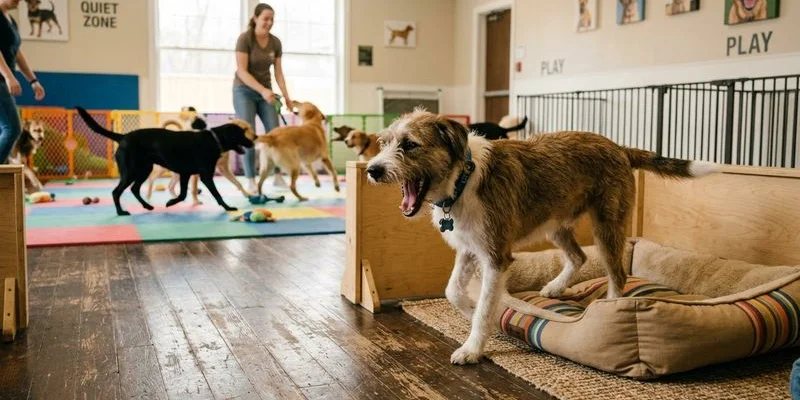
Open Play vs. Crate Rest at Daycare: Which Is Better for Your Dog?
Every dog possesses a unique personality, meaning some thrive with extra social time while others prefer quiet enrichment. Our staff takes the time to understand your pet as an individual to determine the exact answer to Open Play vs. Crate Rest at Daycare: Which Is Better for Your Dog? A one-size-fits-all approach simply does not work for canine behavioral health.
We use all-inclusive pricing so you never worry about surprise fees for rest periods or individual attention.
Proper care makes your long work days much easier to manage. We invite you to contact us at 919-617-0849 or visit our facility at 600 Park Offices Drive, Suite 300, in Durham, NC. Operating hours run from 6:30 AM to 7:30 PM to easily accommodate your busy schedule. Our team looks forward to meeting your best friend soon.
Want the Best Care for Your Dog?
Schedule a free Interview Day and see why Durham pet parents trust our certified counselors.
Schedule Free Interview Day